“A Little Less Praise”: PM’s Interruption Turns Health Conference Moment into Debate
At a UHFPO meeting, the Prime Minister asked the Health Minister to curb his praise; critics say the exchange highlights questions over priorities at official events
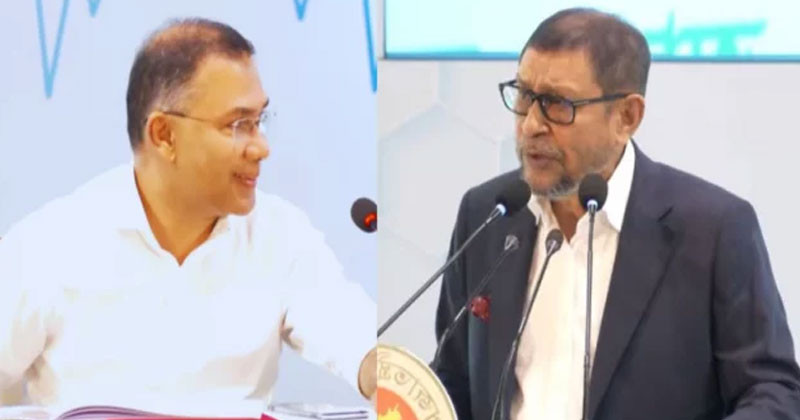
The Upazila Health and Family Planning Officers (UHFPO) conference was organised to discuss health-sector problems in the field, the pressures on upazila health complexes and healthcare for ordinary people. But remarks by the Health Minister praising Prime Minister Tareq Rahman came to dominate the event. The Prime Minister eventually took the microphone and interrupted him, saying with a smile: “Minister, a little less praise, please.”
The incident took place on 18 April 2026 at the UHFPO conference at the Osmani Memorial Auditorium in the capital.
During his address, the Health Minister praised Tareq Rahman’s leadership, achievements and initiatives. As the praise continued, the Prime Minister intervened with a brief remark. The audience laughed, and the exchange later became a subject of discussion on social media and in political circles.
Praise Overshadows a Conference on Health Services
The conference was intended to assess healthcare at the upazila level. Health complexes and the officials who run them are central to services in remote areas. Field-level concerns include shortages of doctors and staff, gaps in medicine supplies, inadequate equipment, patient pressure, limited emergency care and infrastructure constraints.
Yet a substantial part of the minister’s remarks focused on praising the Prime Minister. It was during that address that Tareq Rahman said, “A little less praise, please.”
The moment amused those present, but it also prompted a broader question: how much personal praise should be considered appropriate in ministers’ speeches at official events?
Criticism of a Culture of Sycophancy
Praise of senior political leaders at official and political gatherings is not new in Bangladesh. Such events have at times drawn criticism for excessive glorification of top leadership.
Critics say personal flattery can displace discussion of policy and practical problems. At conferences for government officials, where sector-specific challenges and solutions are expected to be addressed, letting political praise dominate can weaken discussion in the public interest.
The issue is especially significant in healthcare, where decisions directly affect lives and access to treatment. Vacant posts for doctors at upazila facilities, shortages of essential medicines, limited diagnostic services, and gaps in emergency care are among the problems field officials face and need solutions.
Against that backdrop, the exchange has raised a pointed question: at a health conference, should the focus be on healthcare or on praising political leaders?
The Prime Minister’s Brief Reply
The Prime Minister’s response became the most discussed part of the episode. It is common for a chief guest to receive thanks and praise at government functions, but his own intervention made this exchange stand out.
His brief request—“Minister, a little less praise, please”—became one of the event’s most talked-about moments. Some in political circles viewed it as a light-hearted joke; others saw a possible message about excessive personal praise at official functions.
Whatever the interpretation, the sequence was clear: while the Health Minister was praising the Prime Minister, the Prime Minister himself asked him to stop.
Questions About What Ministers Say at Official Events
People expect ministers to identify problems within their portfolios, describe conditions on the ground, explain shortcomings and outline possible solutions.
The Health Ministry is no exception. When field officials meet to discuss the health system, hospital management, staffing shortages, medicine and equipment supplies, patient loads, working conditions for health workers and service quality are expected to be central topics.
The conference exchange has therefore put the relevance and extent of praise for the Prime Minister under discussion.
A Brief Remark, a Wider Question
The incident at the 18 April UHFPO conference has renewed discussion about political praise at government functions. The Prime Minister’s “a little less praise, please” remark was not viewed solely as a light-hearted moment.
It also drew attention to a broader question about official events: how much time should go to praising those in power, and how much to discussing people’s real concerns?
In healthcare, where treatment, lives and wellbeing are at stake, the natural expectation is that accountability, frank discussion of problems and work on solutions should take precedence over praise.
That expectation is why the 18 April exchange has continued to draw attention. When a minister’s praise is interrupted by the Prime Minister himself, the moment may be humorous, but it also prompts debate over whether public-interest discussion is receiving enough space at official events.