Bangladesh’s Two-Tier Dialysis: Advanced HDF Cuts Death Risk, but Most Kidney Patients Can’t Get It
A dialysis technique linked to nearly a one-quarter drop in deaths in a landmark European trial is confined to a few private hospitals in Dhaka, while most of the country’s kidney failure patients struggle to afford even basic treatment.
An estimated 800,000 people with failed kidneys in Bangladesh need dialysis to survive, yet only about 30,000 receive it regularly, according to the Bangladesh Institute of Development Studies (BIDS). Against that backdrop, a more advanced treatment, hemodiafiltration (HDF), is gaining ground internationally but remains almost entirely out of reach at home.
HDF is currently available only at a small number of specialised private hospitals in Dhaka. For most patients, high costs, gaps in water purification, a shortage of skilled staff, and the lack of a timely fistula stand in the way.
Beyond conventional dialysis
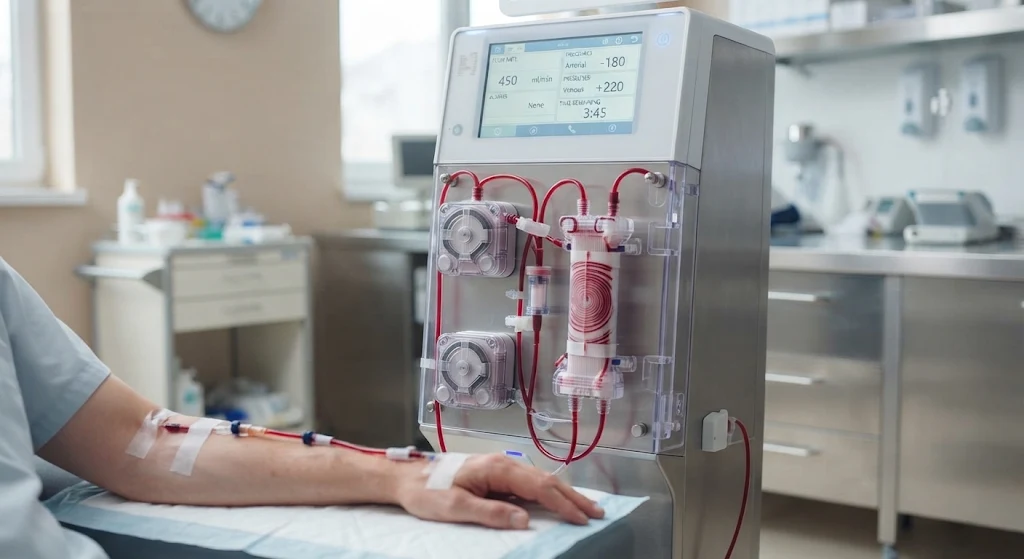
Dialysis takes over the kidneys’ job of clearing waste and excess fluid from the body. Standard hemodialysis (HD) does this mainly through diffusion, which pulls small waste molecules out of the blood.
HDF adds a second mechanism, convection. This lets it remove not only small molecules but also some middle-sized harmful substances, including beta-2 microglobulin, more effectively. During treatment, blood passes through a high-flux dialyzer while highly purified substitution fluid is added to the bloodstream. In online HDF, the machine produces that fluid on site under strict quality checks.
In suitable patients, HDF may improve the clearance of these toxins, and some patients experience steadier blood pressure during sessions and less discomfort afterwards. The same benefits, however, cannot be guaranteed for everyone.
What the research found
The case for HDF was strengthened in 2023 by the CONVINCE trial, published in The New England Journal of Medicine. The study followed 1,360 patients across 61 centres in eight European countries for roughly 30 months.
By the end, 21.9 percent of patients on conventional high-flux dialysis had died, compared with 17.3 percent of those on high-dose HDF. That means a mortality rate about 23 percent lower in the HDF group.
Still, the results cannot simply be transferred to every patient in Bangladesh. Whether HDF is the right choice depends on the patient’s health, the type of treatment, the dialysis dose, and the infrastructure available.
A heavy financial toll
The BIDS study also found that 92.87 percent of families caring for a dialysis patient fall into severe financial distress. Around 19.5 percent of patients cut back on prescribed sessions because they cannot pay, and many abandon treatment after a few months.
At government hospitals, a single session of conventional dialysis costs about Tk 400 to Tk 1,000; at private hospitals, it can run to several thousand taka. If basic dialysis is already a struggle, the higher-priced HDF is beyond the reach of most families.
Money, water and machines
HDF relies on special dialyzers, substitution fluid, and imported consumables, so each session costs more than standard hemodialysis. Over years of treatment, that gap adds up.
Water is the second hurdle. Because online HDF delivers fluid straight into the bloodstream, the fluid must be ultrapure. Centres need double reverse osmosis (Double RO) treatment, routine testing and tight quality control, and whether most dialysis centres in Bangladesh have this capacity remains in question.
Machines are the third. Many hemodialysis machines cannot perform HDF, which requires dedicated HDF-capable equipment, compatible dialyzers, and technical support. The International Society of Nephrology (ISN) puts the number of hemodialysis centres in Bangladesh at just 0.63 per million people. The country also lacks enough trained nephrologists and dialysis technicians.
Fistula: the missing link
How a patient is connected to the machine matters too. An editorial on the CONVINCE findings observed that HDF’s benefits appeared mainly among patients with a permanent arteriovenous (AV) fistula. This is a surgical link between an artery and a vein in the arm that boosts blood flow, and high-dose HDF depends on that higher flow.
In Bangladesh, few patients start dialysis with one. A 2022 study at BIRDEM found that 91.6 percent began dialysis using a temporary catheter. Without timely fistula surgery after diagnosis and greater patient awareness, new HDF machines alone will deliver limited results.
Closing the gap
Because kidney care in Bangladesh is still largely paid out of pocket, expanding HDF will depend on deliberate public policy. Steps could include assessing a phased rollout of HDF-capable machines and ultrapure water systems in major government hospitals, cutting costs through local or bulk procurement, and training nephrologists and technicians with regular quality monitoring.
Subsidies through public-private partnerships, dedicated support for poor patients, and health insurance coverage for kidney treatment would also help, along with faster treatment after diagnosis and timely fistula creation.
For those who need it, dialysis is not optional; it keeps them alive. As long as advanced care stays within the walls of a few institutions, it will mirror a wider divide in the health system and raise a pressing question: will life-saving treatment in Bangladesh remain a privilege of the well-off?