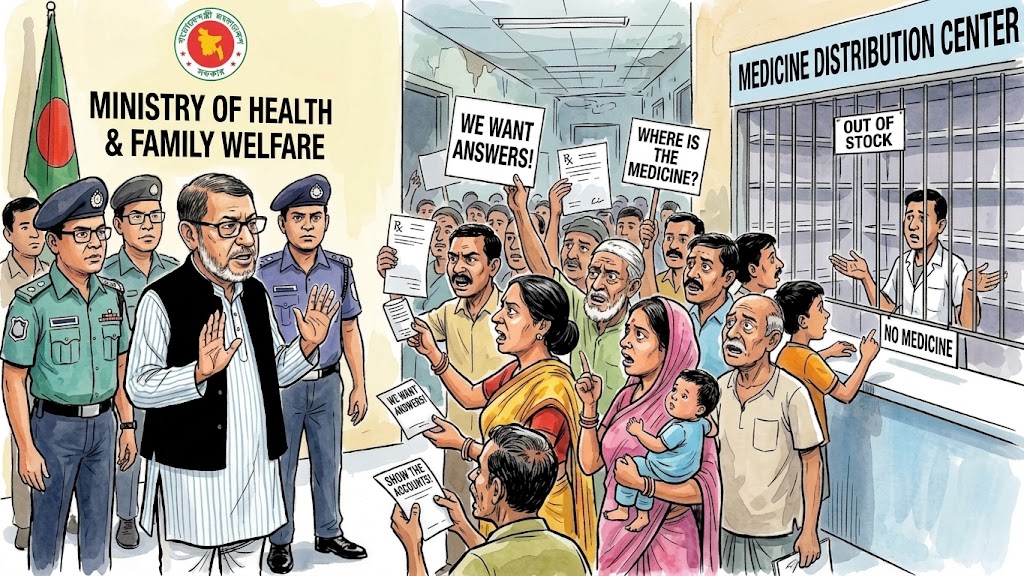
Empty Medicine Shelves, Silent Ministry: Public Demands Accounting from the Health Minister as Government Hospitals Struggle
PPRC survey finds availability of essential medicines at only about 22 per cent; the situation is even grimmer in larger hospitals
An opinion article published in Jago News offers fresh evidence that failing to get medicines at government hospitals is still an everyday reality. The PPRC survey cited in the article says that in the 22 government healthcare institutions reviewed, the availability of essential medicines was only about 22 per cent. For people who cannot afford private treatment, the public system is the only hope. In roughly three-quarters of cases, that system cannot give them their medicines.
The Crisis in Numbers
- Availability of essential medicines in tertiary-level hospitals is only 11.5 per cent.
- At the secondary level, the figure is 23.9 per cent.
In other words, medicine supplies are weakest in the very hospitals that treat the most complex cases. This contrast does not point only to low supply. It also exposes flaws in managing where, and at which level, medicines get stuck. When a patient referred to a large hospital cannot get medicines there either, the continuity of treatment breaks at exactly the most critical moment.
“Supply Didn’t Arrive” Is No Way Out
The Ministry of Health and Family Welfare is responsible for the entire process of purchasing, stocking and delivering medicines to patients, and it is headed by Minister Sardar Md. Sakhawat Hossain. If there is a problem at any stage, the excuse that supply did not arrive cannot be used to avoid responsibility. Finding out why supply did not arrive, where it got stuck and who is responsible is the ministry’s own job. If this information does not come into the open, it is hardly surprising that questions arise about the minister’s leadership.
Patients Buy Medicines from Their Own Pockets
The burden of the shortage ultimately falls on the patient. If medicines are not available at a government hospital, the patient has to buy them outside. For poor families, this means incomplete treatment at times, reduced doses at others, and sometimes stopping treatment altogether. In this way, administrative failure directly touches people’s right to life and health.
Blaming the Past Won’t Do
The problem is long-standing and structural, as the article’s analysis also notes. But this does not reduce the responsibility of the current leadership. If up-to-date information on medicine stocks, the causes of supply obstacles and a timeline for overcoming the shortage are still unavailable, questions of accountability will inevitably arise.
What Must Be Made Public
- An up-to-date list of what medicines are in stock, and how much, in each hospital
- Where and why supply is stuck
- A timeline for overcoming the shortage, and an account of which officials hold which responsibilities
Empty medicine shelves are certainly administrative negligence, but more than that, they are a crisis of accountability. If the ministry’s leadership does not answer, the question will come back to them.