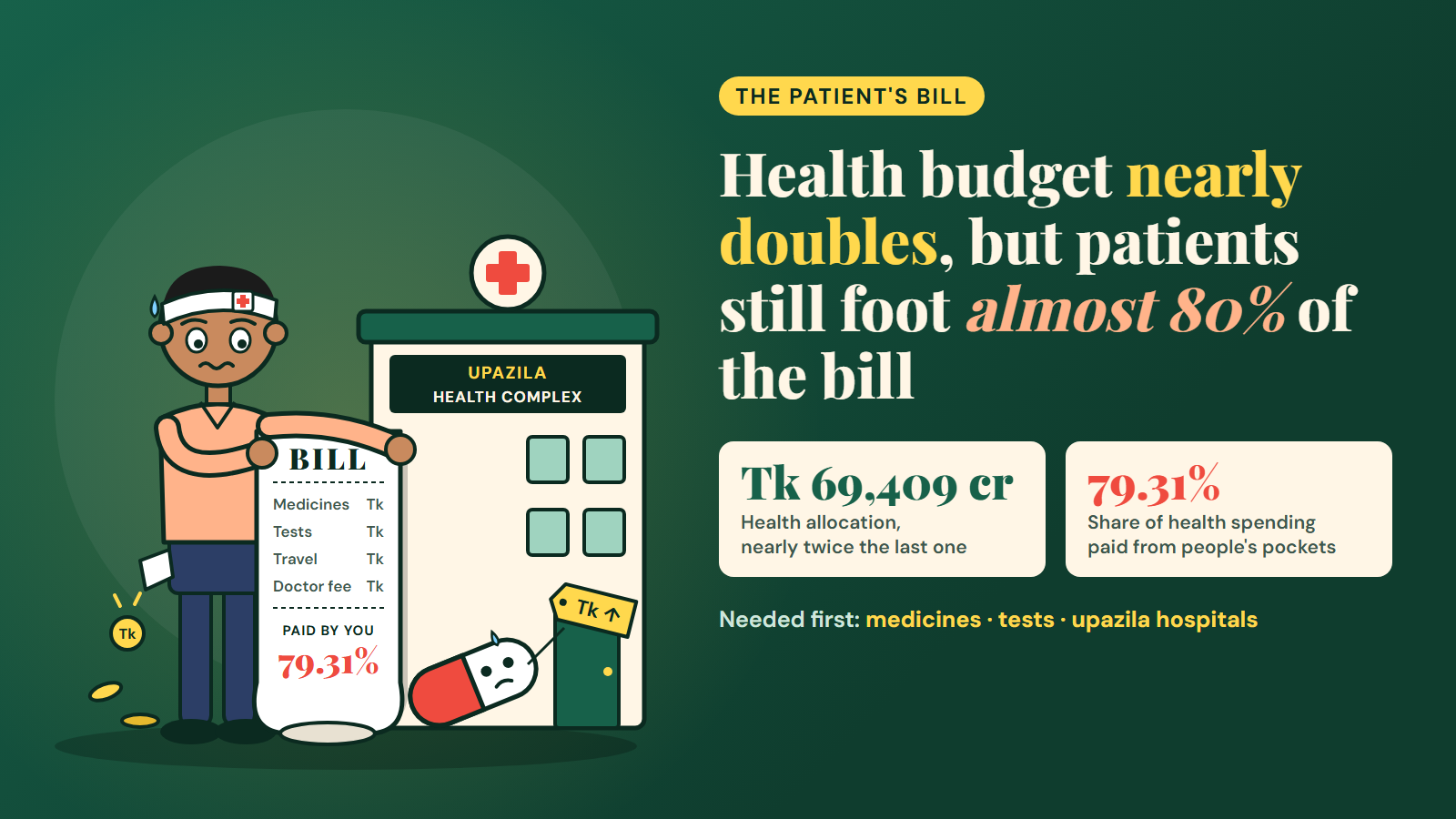
Health budget nearly doubles, but patients still foot almost 80% of the bill
Unless the upcoming Tk 16,000 crore purchase plan targets medicines, diagnostic tests, and upazila hospitals, ordinary people may feel little of the Tk 69,409 crore boost.
For most families in Bangladesh, the health budget is not measured in crores. It is measured at the pharmacy counter, at the diagnostic lab, and in the cost of travelling to a hospital that can actually treat them.
That is the central contradiction facing the country’s health system. Government allocation for the sector has climbed to Tk 69,409 crore, nearly twice the earlier figure, yet the burden of paying for treatment still falls overwhelmingly on patients themselves. Health expenditure statistics show that around 79.31 percent of total health spending in Bangladesh comes directly out of people’s own pockets.
If patients continue to pay for most of their medicines, tests and other treatment costs when they visit a hospital, the benefits of higher state spending will remain open to question. This time, the accounts must be settled not only in the budget, but in the patient’s wallet.
Where the Tk 16,000 crore goes matters
The Ministry of Health and Family Welfare is preparing procurement and tenders worth roughly Tk 16,000 crore. The amount itself is less important than its direction: whether it buys things that make care cheaper and easier to reach, or ends up locked in projects and equipment whose benefits never reach ordinary people.
Competitive bidding and fair prices are essential, but so is a simple test for every item on the list: will it reduce what a patient has to pay, or make treatment easier to get?
Fix the foundations first
Upazila and district hospitals remain among the weakest links in the system. Expanding costly specialised services makes limited sense while these facilities still lack essential medicines, basic tests, emergency care and skilled staff.
Dialysis centres, cardiac catheterisation labs and advanced technology are undoubtedly needed. But if a patient in a remote area still has to travel to a district town or to Dhaka for a routine test, a handful of high-tech centres will not fix the wider crisis. Primary and secondary care must be strengthened first.
Count results, not purchases
Once the Tk 16,000 crore has been spent, the question should not just be how much was spent, but what it achieved. Among the measures that matter:
- How many patients received free or low-cost medicines?
- How many hospitals expanded their diagnostic capacity?
- How many of the machines bought are actually in use?
- How many new health workers were recruited?
- By how much did out-of-pocket spending fall?
Without answers to these questions, it will be hard to call large-scale purchasing genuine progress.
Public money, public scrutiny
Opening the procurement process to civil society, health specialists and professional organisations, along with independent audits and evaluations after purchases are made, would help ensure the money serves those it is meant for.
The question now is whether the government can deliver a procurement system in which the quality of patient care, not the size of the spending, is the benchmark. The answer will decide whether the bigger budget brings real change to Bangladesh’s hospitals, or only a bigger bill.