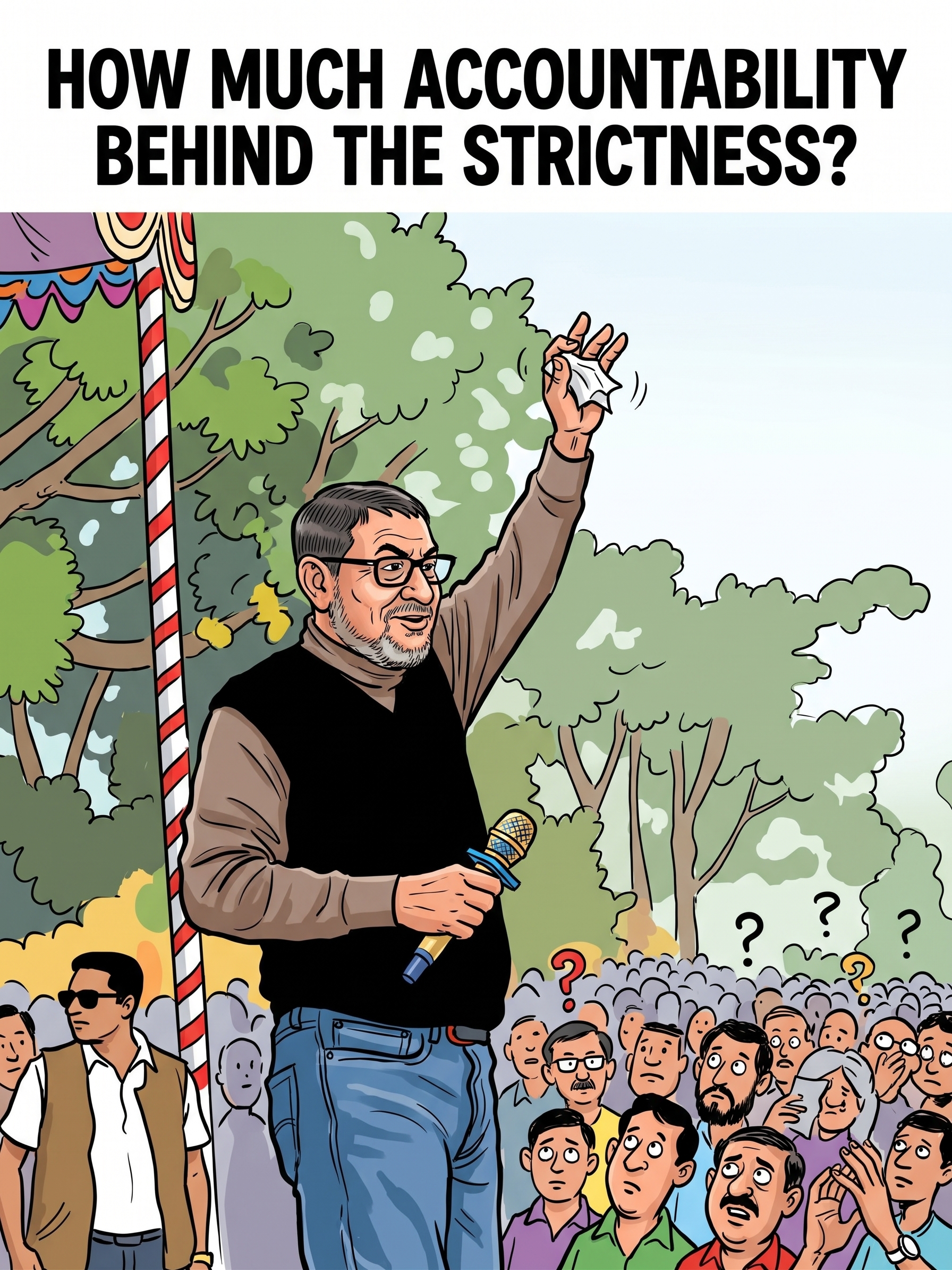
How Much Accountability Behind the Strictness?
Alongside hospital raids, license cancellations, and actions against doctors, questions are arising regarding financial transactions, wealth, political spheres, and administrative decisions
Sardar Md. Sakhawat Hossain Bakul took charge as the Minister of Health and Family Welfare with the announcement of making the health sector corruption-free, breaking up syndicates, and improving the quality of service in government hospitals. Since then, a trend of strictness has become visible in his actions through successive severe measures—sometimes taking action against doctors through sudden hospital visits, sometimes canceling hospital licenses on allegations of irregularities, and sometimes issuing public warnings against deep-rooted corruption in the health sector.
However, alongside this strictness, more questions have arisen. Public counter-statements have emerged surrounding allegations of financial transactions against the minister. Allegations of occupation and extortion at the local level have been raised against his political sphere. News of an investigation by the Anti-Corruption Commission (ACC) regarding the abuse of wealth and power in the past has also been published. The incident of withdrawing the order to remove the Civil Surgeon in Chandpur within two hours in August has also raised questions about the decision-making process. Altogether, a debate has been created over his style of discharging duties.
Consequently, the question now is not just how strict the minister is, but rather how transparent, evidence-based, and equally applicable his decisions are to everyone.
Death of Six Newborns, License Cancellation, and Allegations of Crores of Takas
In June 2026, the government canceled the license of Ad-din Hospital in Moghbazar, Dhaka, following the death of six newborns. During the investigation of the incident, the existence of a bakery or oven factory on the hospital’s roof also came into discussion. Amidst questions about the hospital’s management, security, and healthcare environment, the Health Minister’s strict stance became public.
Meanwhile, at an event in Narsingdi, the minister alleged that the hospital authorities had tried to give him crores of takas to save their license. After this serious allegation, the executive director of the Ad-din Foundation held a press conference denying it and challenged the minister to publish evidence supporting the claim.
Here lies the big question of the investigation—is there any document, communication record, testimony, or investigation report of the offer to give crores of takas? If there is, has it been made public? And if not, what was the basis of such a serious allegation?
However, it is important to view the legality of taking government action against the hospital and the allegation of financial transactions as two separate issues. An administrative decision does not automatically prove an allegation of financial transactions. Similarly, the hospital authorities’ denial does not automatically prove the allegation false either. Documents and an independent investigation are necessary to determine the truth.
Sudden Inspection, 58 Doctors, and the Question of Strictness
The minister’s strict stance also came to the forefront during an inspection of the National Institute of Mental Health and Hospital. During a sudden visit in March 2026, he expressed dissatisfaction with the late attendance of doctors and the unclean environment of the hospital. Later, news of taking cautionary or show-cause measures against 58 doctors was published.
Ensuring the timely attendance of doctors in government hospitals and providing proper care to patients is undoubtedly the responsibility of the administration. But questions have been raised about the application of the measure. Was the complaint against each doctor verified separately? Were they allowed to explain the reason for their absence? Was there any scope for administrative review after the measures were taken based on the information from the sudden inspection?
Although the goal of establishing discipline and ensuring accountability is the same, the method used determines how just and effective an administrative step is.
The Withdrawal Decision Changed in Two Hours
This question about the decision-making process has become stronger with the Chandpur incident. According to a Prothom Alo report, around 10:30 am on August 9, 2026, the Health Minister went to Haimchar Upazila Health Complex in Chandpur on a sudden inspection. There, besides various irregularities and mismanagement, the lack of rabies vaccines caught his attention. He immediately called the ministry and ordered the ‘stand release’ or withdrawal of Chandpur’s Civil Surgeon Mohammad Nur Alam Din.
But two hours later, around 12:30 pm, the minister went to the Chandpur 250-bed Government General Hospital, spoke with the Civil Surgeon, and withdrew that decision. Seeing the clean environment of that hospital, he also expressed satisfaction in front of journalists. The Civil Surgeon told Prothom Alo that the minister was somewhat angry because the rabies vaccine had run out in Haimchar, but later he forgave him.
From an administrative perspective, ordering the withdrawal of a district-level top health official is a serious decision. If it has to be taken back within two hours, the question naturally arises—what information was verified before making the decision? Was the withdrawal order given before determining whose fault it was—the district civil surgeon’s or the supply and procurement system’s—for the vaccine stock running out at an upazila complex?
The manner in which the decision was changed also raises questions. The published report does not mention any investigation or new information behind reversing the decision; rather, it speaks of the minister’s satisfaction at another hospital and a conversation with the Civil Surgeon. The language of ‘forgiving’ is also noteworthy. Accountability is a matter of institutional process, not personal anger or forgiveness. A decision made as a momentary reaction and reversed as moods change indicates a lack of administrative seriousness and responsibility. This also sends a message to officials that the minister’s immediate satisfaction or dissatisfaction, rather than rules and evidence, is the criterion for decisions.
In this tug-of-war, the main problem has been obscured. The rabies vaccine is life-saving for people bitten by animals, including dogs. Why did the vaccine run out in Haimchar, when will new supplies arrive, and what is the stock situation in other upazilas—there is no mention of these in the published reports.
Of course, it can be argued on the minister’s behalf that realizing a mistake and correcting a decision is positive. He also gave assurances of quickly solving the infrastructure, manpower, and ICU problems of Chandpur Sadar Hospital. But if there were a verification system in place before correcting, the need for correction would not have arisen. And it also remains to be seen to what extent the assurances are implemented.
A ‘Syndicate-Free’ Health Ministry—How Much in Reality?
Bakul has spoken multiple times about a strict stance against corruption and syndicates in the health sector. He has also promised to make the Health Ministry 100% corruption-free and to break up syndicates. But the long-standing reality of this sector is more complex. For years, there have been allegations of irregularities and influential contractor groups surrounding medicines, medical equipment, cleanliness, food supply, construction, and various service contracts in government hospitals.
Therefore, the real test now is in documents, not in statements. After taking charge, in how many large tenders has competition been ensured? How many contracts have been canceled? How many contractors or officials have been punished on charges of irregularities? What changes have come about compared to before in the purchase of medicines and equipment in government hospitals? Without answers to these questions, it is difficult to measure the claim of a ‘syndicate-free health sector’.
Burden of the Past, or Solution for the Present?
The Health Minister has given statements blaming corruption and the looting of money during previous governments for the current crisis in the health sector. According to his version, due to irregularities of the past, upazila health complexes do not even have enough funds to buy basic medical supplies like gauze, bandages, and syringes.
Investigation into past irregularities is necessary. But for a sitting minister, it is simultaneously more important to address the current deficit. Which upazila health complex has what deficit, how much money has been allocated, what amount of medicine and equipment has been supplied, and where that money has been spent—it is possible to get a real picture of change by publishing this information.
Determining liability for past failures and solving current crises—both can proceed simultaneously. In fact, both are necessary for an effective administration.
Allegations Regarding the Political Sphere Too
Alongside the minister’s administrative activities, allegations have also been raised at various times regarding his political sphere. Towards the end of 2025, allegations of land grabbing, controlling the sand business, extortion, and nepotism against a section of his followers in Narsingdi were published at the local level. Allegations also arose of indirectly protecting some Awami League leaders and activists.
These allegations are certainly subject to verification. The publication of an allegation in local political statements or news reports does not mean it is proven. To verify the truth of an allegation, lawsuits, official documents, land records, business transactions, and the statements of the concerned persons are required.
In this context, at a political meeting in Monohardi on August 28, 2026, Bakul said there would be no place for any extortionist, grabber, terrorist, or criminal in the BNP. The real test of this announcement will be what action the party or legal authorities take if an allegation arises against any person in his political sphere.
Old Questions About Wealth
Questions about wealth surrounding Bakul are also not new. In September 2024, news was published of an ACC investigation against him regarding abuse of power and acquiring illegal wealth. At that time, investigations into his assets, including flats, land in Dhaka, and investments in various institutions, came to the media.
However, the initiation of an investigation and the proving of a crime are two different things. Without knowing the final outcome of the investigation, whether a case was filed, and what similarities or discrepancies existed between the wealth declaration and the information found in the investigation, one cannot reach a final conclusion on the allegations.
Similarly, news has been published in the past about assets in his wife’s name. One report mentioned multiple flats in Gulshan and shares in various companies in his wife’s name. But having assets in a family member’s name is not in itself proof of acquiring illegal wealth. The source of assets, income, purchase price, ownership, and income tax documents are important here.
Statement vs. Reality—The Biggest Test
Questions of accountability and change have also arisen in Bakul’s political statements. In November 2024, he called on the interim government to hold elections quickly according to the people’s expectations. Later, after taking charge of the Health Ministry, the same test of administrative accountability was created for him as well.
The success of a minister in the Health Ministry cannot be measured solely by how many officials were show-caused or how many institutions were taken action against. Rather, it must be seen—
• Whether the quality of service in government hospitals has improved;
• Whether the shortage of medicines has decreased;
• Whether the attendance of doctors has become regular;
• Whether competition and transparency in government procurement have increased; and
• Whether equal action is being taken in investigations of corruption allegations, regardless of party affiliation or identity.
Questions That Still Need Urgent Answers
Therefore, it is urgent to put forward a few questions regarding the activities of the Health Ministry under Bakul’s leadership:
- What evidence is there supporting the allegation of crores of takas being offered surrounding the Ad-din Hospital?
- What process was followed in taking action against the 58 doctors?
- Based on what information was the order given to withdraw the Civil Surgeon of Chandpur, and what was the reason for changing it after two hours?
- Why was there a shortage of rabies vaccines at the upazila level, including Haimchar, and what measures have been taken to solve it?
- How many visible results have been obtained so far in the anti-corruption and anti-syndicate drives of the Health Ministry?
- What changes have come about compared to before in the procurement and tenders of government hospitals?
- Has there been any independent investigation into the allegations raised against his political sphere?
- What was the decision after the ACC investigation in the past?
- Above all, how much real benefit are the common people in the health sector getting from his announced changes?
The answers to these questions can be found not through political statements, but through documents, government decisions, investigation reports, court records, procurement information, and statements from the concerned parties.
The Health Ministry is an institution where a single administrative decision can have a direct impact on the healthcare of patients, doctors, hospitals, and crores of people. Therefore, just as the minister’s strictness is necessary, accountability for that strictness is equally necessary.
Ultimately, the question is not how strict Bakul is. The question is how evidence-based each of his strict decisions is, how transparent they are, and whether they are being applied equally to everyone under the same rules. That answer alone will determine how much the announcements of change in the Health Ministry are translating into real reform.