
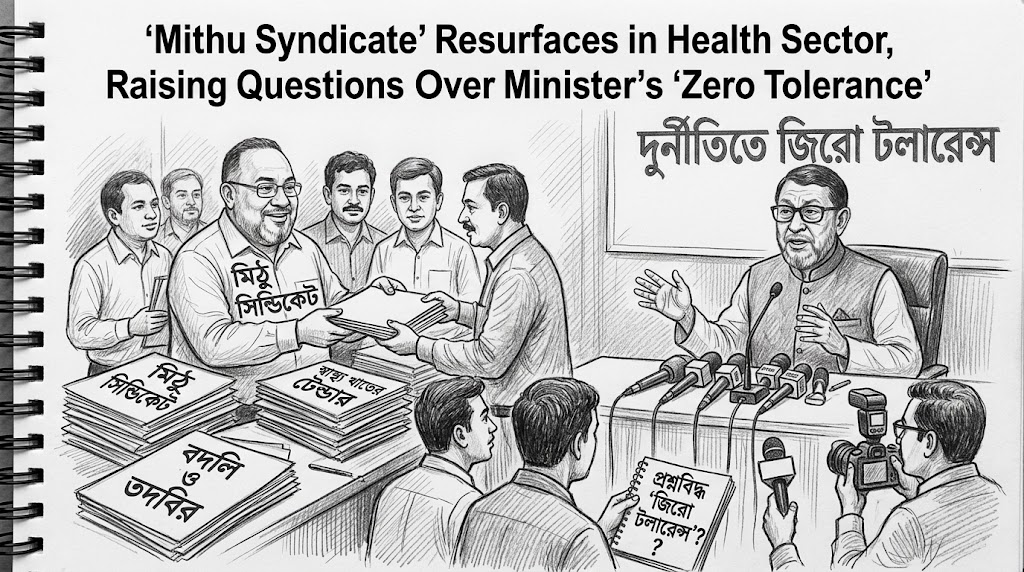
‘Mithu Syndicate’ Resurfaces in Health Sector, Raising Questions Over Minister’s ‘Zero Tolerance’
Allegations are once again circulating that the so-called ‘Mithu Syndicate’ — a group that drew attention under the previous government for its influence over health-sector procurement and tenders — has become active again. According to those familiar with the matter, individuals linked to this group, who had previously wielded influence over various health-sector purchases and tenders, are now trying to regain a foothold in government procurement. It is also alleged that after being released on bail, they have been exerting influence through a “back door,” staying out of public view.
If the allegations are true, an inevitable question arises: how is it that this old, allegedly influential contractor network in the health sector is finding room to re-establish itself even after a change in government? An even bigger question is how aware the Ministry of Health and its affiliated departments — under Health Minister Sardar Sakhawat Hossain Bakul, who has declared “zero tolerance” against corruption — actually are of these allegations, and what steps they are taking in response.
Where Is the Gap Between Declaration and Reality?
Declaring a firm stance against corruption is a relatively easy task for political and administrative leadership; the real test lies in translating that declaration into practice within the government procurement and tendering system. If an old, influential group in the health sector has indeed become active again, then identifying and countering it is the responsibility of the relevant ministry and its departments.
This is precisely why the allegations surrounding the ‘Mithu Syndicate’ cannot be dismissed as mere internal chatter among contractors. If there is genuine documentation, tender records, or financial transaction data behind the allegations, they warrant scrutiny. And if the allegations are baseless, the relevant authorities should make that clear as well.
This is where a major question of political and administrative accountability arises for Minister Bakul. At the very moment he speaks of “zero tolerance” against corruption, allegations that the same old group is exerting influence over large-scale procurement and tenders under his ministry create a need for a visible investigation and concrete action.
Who Inside the Ministry Is Pushing These Files Forward?
Questions have already been raised in various quarters about several large procurements in the health sector. New allegations suggest that, with tenders and procurement processes worth billions of taka on the horizon, certain files are being arranged in advance, with influential contractor groups attempting to favour their preferred firms.
The most important question here, however, is: in which tender, which institution, and how exactly is favour being extended? Without public disclosure of the relevant files, bidding conditions, evaluation reports, and work-order details, it is difficult to verify the truth of these allegations.
This is precisely where the ministry’s transparency becomes crucial. If the minister is genuinely committed to a hard line against corruption, there must be transparency in every large procurement process, alongside a mechanism for independently verifying any allegation the moment it is raised.
Is ‘Zero Tolerance’ Just Rhetoric, or Backed by Real Action?
The biggest test of the health minister’s declared position will be the actual conduct of the institutions under him. The fact that an alleged syndicate held influence in the past does not, by itself, directly implicate it in any present irregularity. But when specific new allegations arise against the same group, they cannot simply be brushed aside either.
Questions such as who is participating in publicly funded health-sector procurement, which institutions are repeatedly winning contracts, how much genuine competition exists in the bidding process, at what prices similar goods or equipment have been procured elsewhere, and whether tender conditions are tailored to favour a particular institution — all of these can be answered through a review of the relevant documents.
If the minister wishes, he can demonstrate the real-world application of his declared ‘zero tolerance’ policy by enabling the disclosure of this information and independent verification. Conversely, if allegations remain unresolved for long periods, or if the same contractor and supplier groups continue to dominate government procurement without any investigation, it is only natural that questions will be raised about the ministry’s declared anti-corruption stance.
The Minister’s Biggest Test Now
Ultimately, the truth of the allegations surrounding the ‘Mithu Syndicate’ should be determined through investigation and documentary evidence. But whether the allegations turn out to be false or true, the Ministry of Health carries a clear responsibility in either case.
If the allegations are proven true, action must be taken against those responsible; if they are found baseless, that too must be clearly stated. For silence, or mere anti-corruption rhetoric alone, resolves neither side of any allegation.
The biggest question facing Health Minister Bakul now is this: will his declared ‘zero tolerance’ become visibly real in the health sector’s tenders, procurement, and contracting system — or will the very groups that wielded influence in the past manage, once again, to carve out a place for themselves under the new political and administrative reality?
| In the end, the credibility of any pledge to end corruption in the health sector will be proven not through statements, but through transparency, genuine competition, clear accountability, and impartial investigation of every allegation surrounding every major public expenditure. |