From 1/11 Politics to the Cabinet: Questions Over Bakul’s Political U-Turn
Reformist stance, distance from BNP, the ‘traitor’ label — how the political equation shifted over time
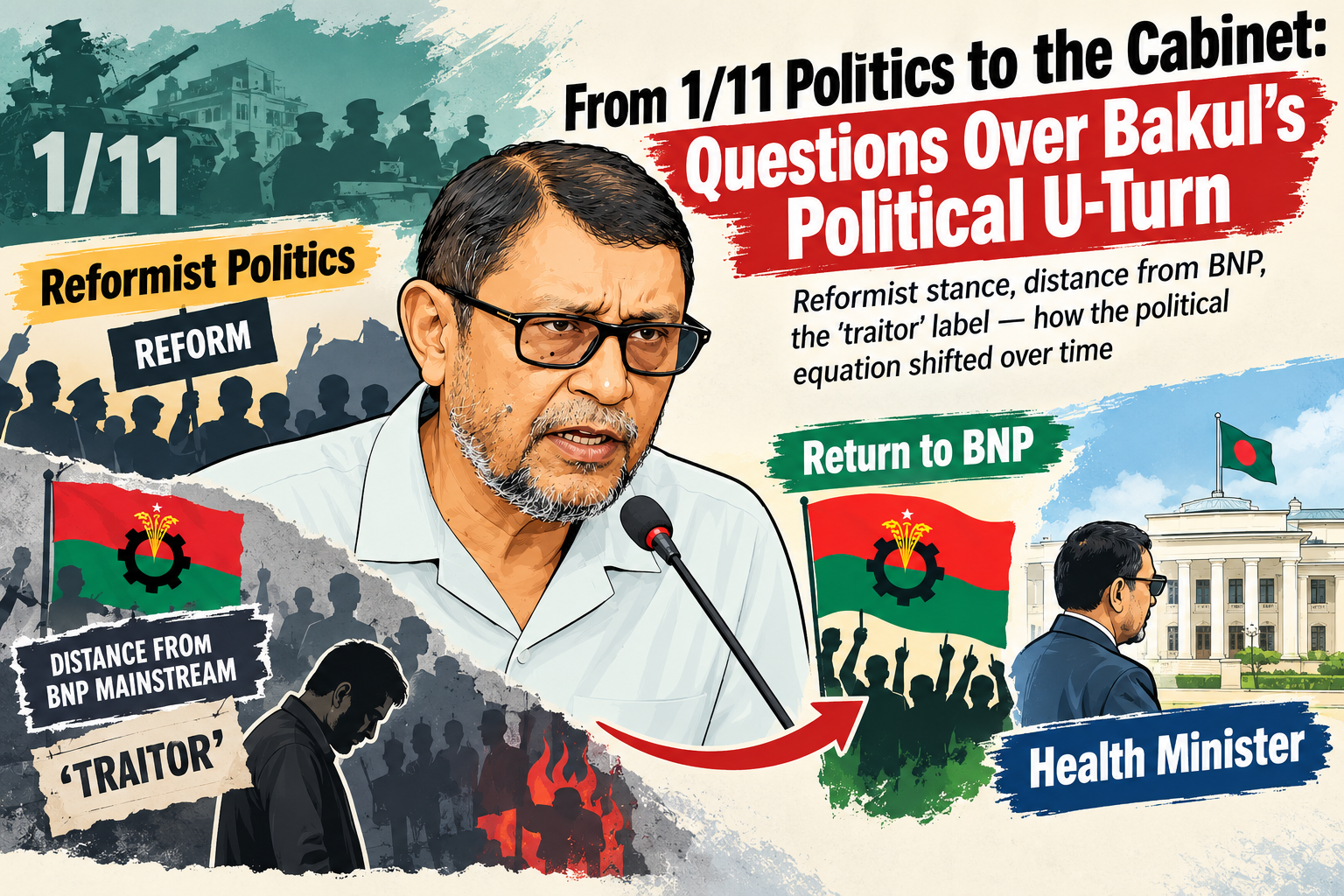
The 1/11 period of 2007 was not merely a chapter in a change in power in Bangladeshi politics; it also triggered intense tension within the country’s two major parties over leadership, reform, and political positioning. There is discussion in political circles that Sardar Shakawat Hossain Bakul was aligned with the reformist faction that emerged inside BNP at the time. He now serves as Health Minister, which is why this chapter of his political past has resurfaced in public discussion.
In the aftermath of 1/11, leaders who broke from BNP’s then top leadership to back party reform became the subject of intense controversy. Bakul has faced similar allegations. Alongside the distance that developed with the party’s mainstream leadership, discussions from various points in time suggest there was also resentment and discontent among his own party’s grassroots over his political stance.
Reformist Politics and Distance from BNP
During the political turmoil of 2007–08, a section of leaders who took a pro-reform position against the authority of Khaleda Zia and Tarique Rahman, then at the helm of BNP, carved out a separate political stance. The allegation that Bakul was aligned with that faction remains one of the most talked-about chapters of his political life.
The consequences of that stance were also politically significant. His critics claim that his distance from BNP’s mainstream widened, and at one point he was pushed out of party politics altogether. There is discussion in political circles that he also faced a sharp backlash within local politics in Narsingdi. Reports even mention that his effigy was burned locally and that he was branded a ‘traitor’ at the time.
Return After a Long Estrangement
The biggest question arises in what came next. The political distance that once pushed him away from BNP’s mainstream did not prove permanent as time passed. After a long political hiatus, Bakul became active again in BNP politics, and his standing within the party’s organizational structure later grew stronger.
This is where criticism of him as an ‘opportunist’ surfaced. Critics argue that taking a stand during a difficult political moment, being cut off from the party’s mainstream because of that stand, and then returning to an important position within the same party once circumstances change, raises questions about the consistency of his political positions.
On the other hand, Bakul’s supporters may explain this as political reconciliation, or simply as a natural adjustment to changed political realities. The word ‘opportunist,’ then, is a political judgment rather than an established fact; before treating it as settled, it is important to verify his own statements from that period, the party’s formal decisions, and the official process by which he later returned to BNP.
1/11 Positioning vs. the Present Position of Power
Perhaps the most-discussed contradiction of Bakul’s political career lies right here. On one hand, during 1/11, he took a pro-reform stance against the party’s established leadership and structure; on the other, he later returned to that very party and gradually rose to an important political position.
Shifting political positions is nothing new — political realities, party dynamics, and the passage of time can all cause leaders to change their stances. But in Bakul’s case, the 1/11 chapter takes on added significance precisely because of his current position of power. The political stance that once pushed him away from BNP’s mainstream, and his emergence years later as part of that same party’s important leadership, has raised questions about his political trajectory.
Bakul’s political past is therefore not merely old history for a man who currently holds the health portfolio. Rather, his position during 1/11, his subsequent political isolation, and the continuity of his eventual return to BNP form an important backdrop for understanding his political career. In the end, the question remains: was this a genuine shift in principled position, or a strategy of adapting himself to a changed political reality?
Answering that question requires weighing his own statements, the party’s documents from that period, and contemporary news reports together. Only then can it become clear how much continuity — and how much change — exists between the Bakul of 1/11 and the Bakul who is Health Minister today.