Polished for a Visit, Forgotten Afterwards: Inside Three Hospitals the Health Minister Raided
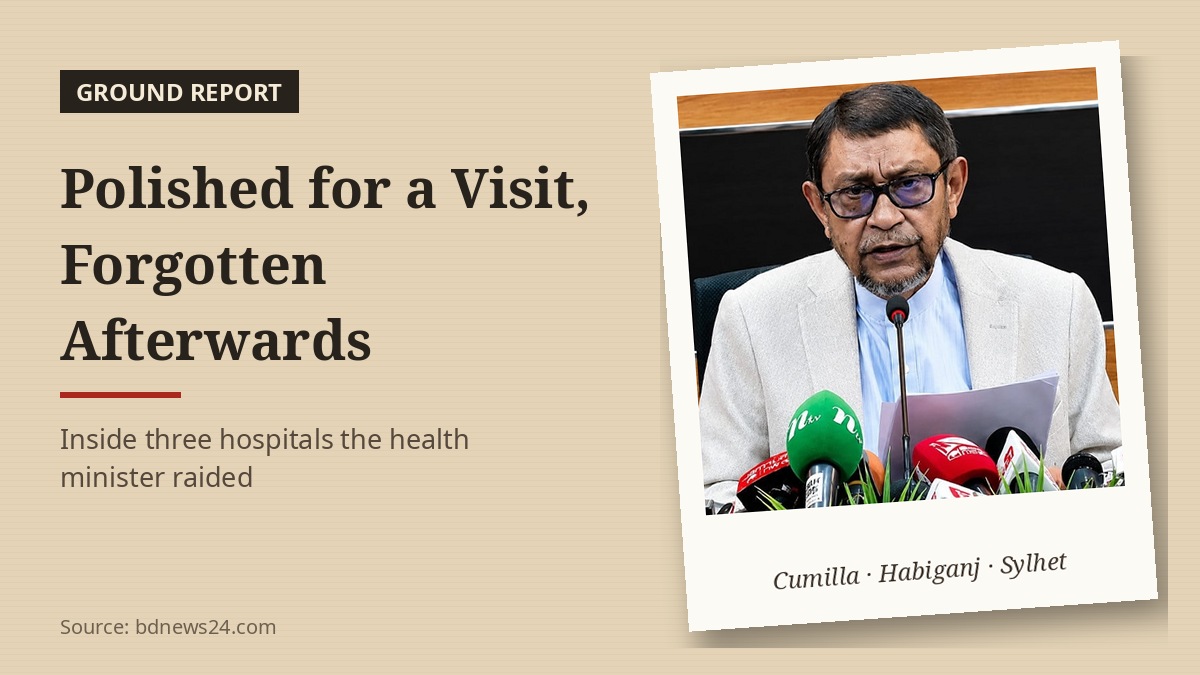
On 5 May, Health Minister Sardar Md. Sakhawat Hossain Bakul walked through the kitchen, wards and cleaning arrangements of Cumilla Medical College Hospital and left with a hopeful remark: perhaps the fear of a ministerial visit would be enough to clean the place up. Four months later, a bdnews24.com team returned and found that fear had done very little.
Stairway corners were stained with betel-leaf spit. Used syringes lay by the dental department. Medical waste sat in open drums, and relatives say the drums ride the same lift as patients. “They put the waste containers right in front of the lift, sometimes with the lids off,” said Samiul Islam, a patient’s relative.
The pattern behind the picture
Since February the minister has dropped in on at least 30 hospitals, among them Satkhira, Naogaon, Jhenaidah, Kushtia, Cumilla, Habiganj and Sylhet. Where he found staff absent he has ordered transfers or dismissals; elsewhere he has simply expressed displeasure. Videos of these scenes spread quickly online and divide opinion.
Reporters visited three of those hospitals to see what came after. In Habiganj, where the minister toured the pharmacy, children’s ward, emergency unit, pathology department and kitchen on 29 August, local resident M Sajlu Mia remembers a tidy hospital and somewhat better service for a few days. Then, he says, it slid back.
Patients there describe a different daily reality. Nurul Haque of Shaestaganj had to pay for his medicine outside. Salma Begum of Baniachong said tests prescribed for her daughter were done elsewhere, and that after admission everything except one daily injection had to be bought outside. The minister promised more doctors and beds that day; reporters could find no sign of either.
In Sylhet, the minister declared in early September that every problem at MAG Osmani Medical College Hospital would be fixed within a week. When reporters visited on a Sunday, they found filth on the stairs, a foul-smelling bathroom in the cardiac ward, and relatives living beside it. The ward holds 120 patients against a planned 40.
What the officials say
Hospital officials rarely dispute the dirt. They point to numbers. Cumilla’s acting director says the hospital needs 126 cleaners but has 53, some of whom are pulled into other jobs. The college principal blames patient numbers around three times the bed count and hopes the return of outsourced hiring will help. Osmani’s deputy director says the 900-bed hospital serves about 3,000 patients daily; its outsourced cleaning crew of 262 compares with a need of 500 to 600. One assistant director insists conditions have visibly improved since the minister’s order, though the accounts of patients and reporters suggest otherwise.
Doctors push back
Some doctors resent how the visits are framed. Their complaint is that missing doctors and rude behaviour make the news while shortages of staff, medicines and equipment, and weaknesses in laboratories, stores and administration, stay in the background. Dr Asif wrote online that inspection footage may look striking on camera but a health system is not a film, and asked whether a hospital’s pathology lab is only a doctor’s responsibility.
The Doctors’ Association of Bangladesh does not deny the minister’s right to inspect and act. Its secretary general, Md. Zahirul Islam Shakil, asks only that complaints against doctors go through proper investigation, and that shortages of staff, medicine and equipment get equal priority. Others fear that publicly scolding doctors could pit them against patients and expose them to public anger.
The minister’s answer
The minister maintains that people are benefiting. He says it is his duty to act when a doctor is missing in office hours, that a show-cause notice comes first, and that action follows the rules if the reply is unsatisfactory. For staffing, he cites a plan to hire 100,000 health workers and to supply equipment down to upazila hospitals.
The report records no timeline for either plan. Until there is one, the pattern seen in Cumilla, Habiganj and Sylhet is likely to repeat: a brief shine after the minister’s car pulls away, then the old routines return, and patients go on paying for what the hospital cannot provide.
Source: bdnews24.com